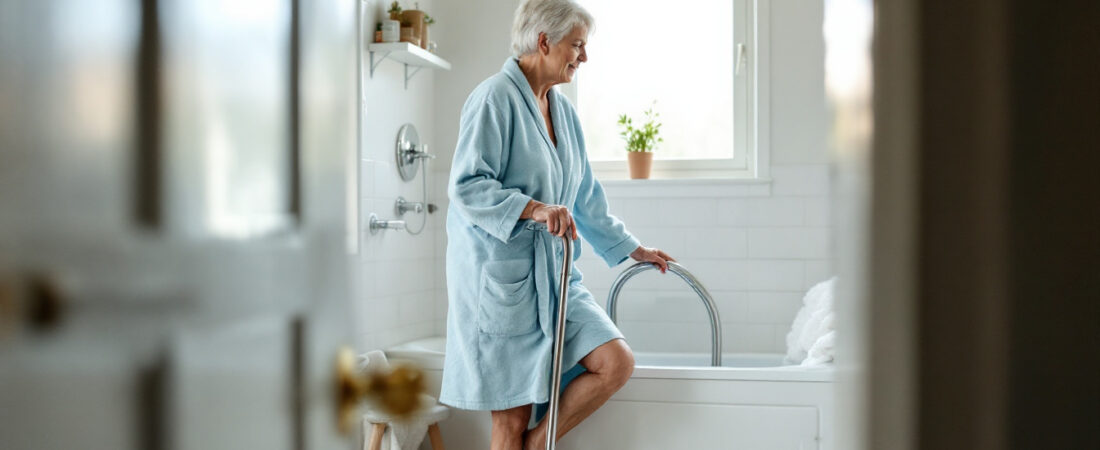
Every year, more than 3 million older Americans visit the emergency room after a fall at home, and the good news is that most of those accidents are entirely preventable with a few smart, affordable changes. Whether you are 62 and still gardening every morning or 75 and thinking about what your home needs to support the next chapter, this guide is packed with specific, actionable ideas you can start this weekend. Think of it less as a checklist and more as a friendly walkthrough of your own four walls.
Want the Free Printable Checklist?
Click the button below to download your free PDE guide.
Start in the Bathroom: Where Most Falls Happen
The bathroom is responsible for roughly 235,000 fall-related emergency visits among adults 65 and older each year, making it the single most important room to address first. The slippery combination of wet tile, low toilet seats, and awkward tub entries creates real risk, but the fixes are surprisingly affordable. A tension-mounted grab bar from your local hardware store runs between $25 and $45 and requires zero drilling, while a non-slip bath mat with suction cups costs under $20 and can be in place within minutes.
Consider raising the toilet seat with a bolt-on riser, available at most pharmacies for around $35. These lifts add 3 to 4 inches of height, which means you are not lowering yourself as far or straining your knees and hips to stand back up. Look for models with armrests built in, because those handles give you a steady push-off point every single time.
If your shower has a fixed showerhead mounted high on the wall, swapping it for a handheld model with a 60-inch hose lets you sit on a shower bench and still rinse thoroughly. Quality handheld showerheads with anti-scald technology start at about $30 and install in under 15 minutes with just an adjustable wrench.
Lighten Up Every Hallway and Staircase
Poor lighting is a silent accomplice in countless home accidents, and the fix is both cheap and deeply satisfying. Motion-activated LED night lights plug directly into standard wall outlets and retail for as little as $8 for a two-pack. Place one at each end of every hallway, one at the top and bottom of each staircase, and one beside the bed so any middle-of-the-night trip to the kitchen is well-lit from start to finish.
For staircases specifically, make sure the overhead light switch is reachable from both the top and the bottom of the stairs. If it is not, a licensed electrician can install a three-way switch for roughly $100 to $150 in labor, which is a very small price for the peace of mind you gain. While you are at it, check that every stair tread is covered with a non-slip rubber strip or secured carpet. Loose carpet edges are responsible for thousands of staircase falls each year and can be re-tacked for almost nothing.
Finally, consider replacing old incandescent bulbs throughout the home with 800-lumen LED bulbs. They produce significantly more light than a standard 60-watt bulb, last up to 15 years, and cost less than $2 each when bought in a 6-pack. Brighter rooms simply mean fewer shadows and fewer missteps.
Declutter the Living Room and Create Clear Pathways
Rugs, power cords, and low coffee tables are among the most common tripping hazards in living rooms, and removing or repositioning them costs nothing at all. Start by rolling up any area rug that is not secured with non-slip rug tape or a rubberized underpad. If the rug is meaningful to you, invest $15 in a roll of double-sided carpet tape and adhere every edge firmly to the floor. Small throw rugs on hardwood floors are particularly dangerous and are best stored or replaced with non-slip alternatives.
Route all lamp and television cords along baseboards using inexpensive cord clips or a $6 cable raceway kit from any home improvement store. Keep furniture arranged so there is at least a 36-inch clear walkway between pieces, which matches the minimum recommended by most occupational therapists and the National Aging in Place Council. If you use a walker or cane, 42 inches of clear path is even better and makes moving through the room feel genuinely comfortable.
Take a fresh look at your favorite chair or recliner as well. If the seat sits lower than 17 inches from the floor, a chair riser or firm seat cushion adds the inches you need to stand up without straining. Look for chairs with sturdy armrests that extend to the front of the seat so you always have something solid to push up from.
Kitchen Safety Upgrades That Take One Afternoon
The kitchen is where people spend a surprising amount of time each day, and a few targeted changes make it dramatically safer without changing the way you cook. First, relocate the items you use most often to countertop level or to shelves between waist and shoulder height. Reaching above your head or crouching below knee level to grab a heavy pot or cast-iron pan is an unnecessary strain on your balance and your joints. Store daily dishes, glasses, and the most-used appliances right where you can see and reach them without stretching.
If you do need to retrieve something from a higher cabinet, use a step stool with a built-in handle rather than balancing on a chair. A quality step stool with a gripping rail costs between $40 and $70 and is worth every cent. Look for models rated to hold at least 250 pounds and featuring rubberized feet that will not slide on tile or linoleum. Keep it in the kitchen rather than stashing it in a closet so you actually use it.
Invest in an automatic stove shut-off device, which monitors burner activity and turns the stovetop off after a set period of inactivity. Devices like the iGuardStove or Wallflower range monitor run between $80 and $130 and connect to your home Wi-Fi, sending an alert to a family member if a burner has been left on. That single purchase protects both your home and your peace of mind every day.
Technology Tools That Watch Out for You
Personal emergency response systems have come a long way since the bulky buttons of the early 2000s. In 2026, wearable alert devices are slim, waterproof, and accurate enough to detect a fall automatically without you needing to press anything. Brands like Medical Guardian and Bay Alarm Medical offer monthly monitoring plans starting at $19.95 per month, with equipment fees that are often waived during promotional periods. Many plans now include GPS tracking so the device works outside the home as well, whether you are at the grocery store or walking the neighborhood.
Smart doorbells with video cameras, such as those from Ring or Google Nest, let family members see who is at your door and even speak to visitors on your behalf through a connected phone app. This reduces the need to rush to the door, which is itself a common cause of falls. Installation is straightforward and usually takes under 30 minutes if your home already has a standard doorbell wiring setup.
For those who take multiple medications daily, an automatic pill dispenser is a remarkably useful tool. These devices hold up to 28 days of sorted doses, sound an audible alert at the right time, and lock remaining doses so accidental double-dosing is impossible. Quality models from MedMinder or Hero run between $30 and $60 per month on a subscription basis and can notify a caregiver by text if a dose is missed. That kind of backup is genuinely reassuring for everyone involved.
Getting Outside Safely: Walkways, Steps, and the Garage
Outdoor hazards deserve just as much attention as anything inside the home. Cracked sidewalks, uneven pavers, and slippery wooden steps account for a significant share of senior falls, and local municipalities will sometimes repair public sidewalk sections in front of private homes for free if you file a simple maintenance request. Check your city or county public works website in early 2026 to see whether such programs exist in your area, because many communities have expanded these services recently.
For private walkways and steps, a bag of quick-setting concrete patching compound from a hardware store costs about $12 and can fill a crack or uneven edge in an afternoon. Apply outdoor grip tape to wooden deck steps and porch stairs, which costs about $10 for a 15-foot roll and provides meaningful traction even when wet. Make sure every outdoor step has a handrail that runs the full length of the staircase, and test that it is solidly anchored by giving it a firm shake. If it wobbles even slightly, tighten the mounting bolts or call a handyman.
Lighting matters outside just as much as inside. A motion-activated floodlight above the garage door or front entrance costs around $25 and runs on standard wiring or even solar power. Position it so it illuminates the full path from the driveway or street to your front door, eliminating shadows that can disguise uneven ground after dark.
Frequently Asked Questions
How much does it typically cost to make a home safer for a senior?
Most foundational safety upgrades cost between $150 and $500 total when you prioritize grab bars, non-slip mats, better lighting, and cord management. Larger modifications like a walk-in shower or stairlift can run $3,000 or more, but many states offer home modification assistance grants for residents 60 and older through Area Agencies on Aging. Check benefits.gov in 2026 for current programs available in your state.
Does Medicare cover home safety modifications in 2026?
Traditional Medicare does not generally cover home modification costs such as grab bars or ramps. However, Medicare Advantage plans vary widely, and some include a home safety benefit that contributes $500 to $1,500 annually toward modifications. Medicaid waiver programs in many states also cover significant home modifications for eligible low-income seniors. An independent insurance counselor through your State Health Insurance Assistance Program, known as SHIP, can review your specific plan at no charge.
What is the single most important home safety change a senior can make?
Installing grab bars in the bathroom, particularly beside the toilet and inside the shower or tub, consistently ranks as the highest-impact single change according to occupational therapists who specialize in aging in place. Falls in the bathroom are among the most serious and most preventable. A grab bar rated for 250 pounds or more, properly anchored into wall studs, can be installed for under $50 and takes less than one hour.
How can a caregiver help a parent make these changes without creating conflict?
Frame the conversation around independence rather than safety concerns. Pointing out that these upgrades help someone stay in their own home longer, rather than suggesting vulnerability, tends to land much better. Offer to do the work together on a specific Saturday and present it as a home improvement project rather than an intervention. Starting with one low-stakes change, like adding a night light, builds momentum and trust before tackling larger modifications.
Your home has supported you through decades of living, and with a handful of straightforward adjustments it can keep doing exactly that for many more years to come. None of the changes in this guide require a major renovation budget or a contractor on speed dial, just a free afternoon, a short hardware store list, and the satisfaction of knowing you have made your space work better for you. If you are ready to take the first step, print this guide, walk through each room with a cup of coffee in hand, and mark off what you can tackle this week.